Methodology
USE OF ITC (information technology and comunication) 
We propose simple ITC activities to give a little leap into the Methodology 2.0, whichenable small and very rewarding experience.
- PowerPoint presentations, Impress or Keynote with the contents of the lesson incomputer screen, with barrel or PDI or hopefully serve only to give a lecture.
- Click activities, JClic going HotPotatoes or hanging on the network other teachers.
- The barrel on white board, with software from the publisher: content in digital form.
- The resources that we collect online, usually closed activities we accede to play and learn.
- Himself Blog / Wiki Classroom or Virtual Classroom, which rarely consult our studentsoutside of class, much less, families (at most other educational resources to store orcopy them to your own blog classroom).
It's time to move forward, to explore new uses (not just new tools or resources) to exceed HotPotatoes activities, the Treasure Hunt and WebQuests.
So, little by little we will publish ICT tasks, methodology and organization with a clear and simple, you are introduced to a change in methodology and skills development.
www.youtube.com/watch?v=m873opno1M0
www.youtube.com/watch?v=wOrTAiiD2Qw
www.youtube.com/watch?v=Eu-Ztd0XMUo
www.youtube.com/watch?v=DnmFfxWjsvs&feature=related
www.youtube.com/watch?v=1YwgaiVnJhU&feature=related
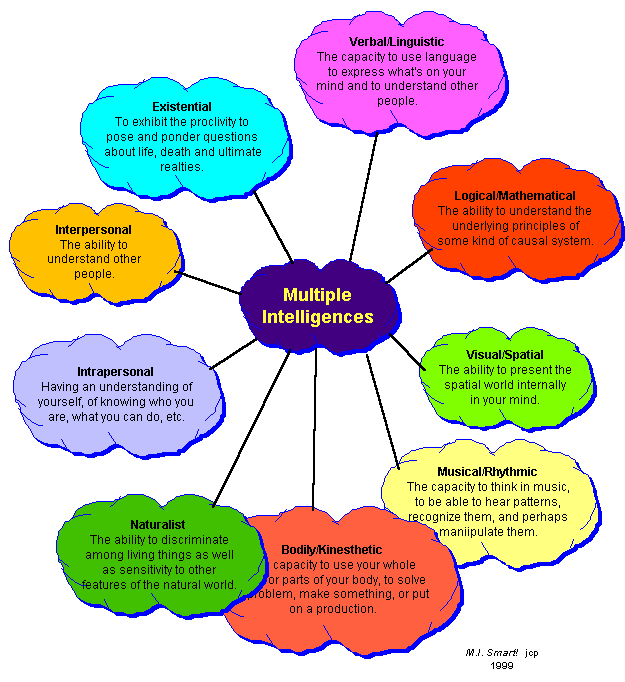
Our work takes into account diversity. Consequently, the activities are very visual, dynamic and funny. Students who are hyperactive will enjoy the activity "Magic Box", as they are required to move around. Students with learning disabilities will have less difficulty in understanding the activities due to the pictures. The same applies to students who have language difficulties; all the activities use several pictures and the words are often repeated. With these visual aids and repetition it will further assist the students understanding.
Additionally, the teacher will adapt themselves to the level of the class and adapt the pace of the learning for each individual.
Therefore, the teacher will try to create a good classroom atmosphere, which means:
- Be fair and do not discriminate.
- Provide opportunities for learners to get to know each other.
- Reject any kind of discriminatory behavior.
- Encourage and teach students to listen to one another.
- Avoid comparing different student´s performances.
Finally, the teacher will adapt the curriculum (objectives, content, methodology, evaluation...) to the characteristics and peculiarities of their students.
TOTAL PHYSICAL RESPONSE 
This method was created by James Asher. It´s part of the ´comprehension approach´ because the importance it gives to listening comprehension. It tries to copy the way a children acquires his native language. No one tells the student when to speak, the student does it by himself, when he is ready…
The principles:
Learning a language must be fun and stress free, this lows anxiety. The understanding of the language comes first than speaking. Initially, the teacher is the director of all student behavior, but at some point when the students are ready to speak they can change roles.
At first, the student´s response is nonverbal. The vocabulary and grammatical structures are emphasized over other language areas. The spoken language is emphasized over written language. The TPR is usually introduced in the students’ native language. After that, the native language would be rarely used. Meaning is clear throught the body movements.
The class phases:
First phase of a lesson is modeling.The teacher commands to a few students.Then performs the actions with them.
Second phase:
These same students demostrate that they can understand the commands by performing they alone. The observers also have the chance to demostrate what they have learned.
The teacher recombines elements of the commands to have students to develop flexibility in understanding.
Third phase: after learning to respond nonverbally to some oral commands, the students learn to read them and write them. When students begin to speak, activities expand to include skits and games.
The evaluation:
The evaluation is acomplished by observing the students’ actions.
Formal evaluation can be conduced simply by commanding individual students to perform a series of actions. Their performance of skits they have created becomes the basis for evaluation.
www.youtube.com/watch?v=pk2uLmT9068&feature=relmfu